
What's inside
As an Amazon Associate I earn from qualifying purchases. This post may contain affiliate links at no extra cost to you.
The best hygrometer for grow tent use is the one whose number you can trust at canopy height, at 3 a.m., from your phone, because a grow tent’s climate is a moving target measured in a box full of microclimates. The air at the exhaust is not the air at the leaves; the sensor beside the light lives in a different climate from the sensor in the corner; and a cheap hygrometer that reads five points low teaches its grower to humidify a tent that is already damp, which is how powdery mildew gets invited by an instrument. This guide compares six real, currently sold thermo-hygrometers graded for grow tents specifically, accuracy and calibration first, data logging and alerts second, placement and probe design third, and teaches the climate literacy that makes the numbers useful: relative humidity read together with temperature as vapor pressure deficit, the placement rules that decide whether any sensor is measuring the plants’ weather or the tent’s plumbing, and the calibration check, a salt test in a sealed jar, that separates an instrument from an ornament in one overnight experiment.
Set the stakes honestly. Humidity is not a background detail in a tent; it is half the climate, and it steers the plant’s drinking, the stomata’s behavior, the mold’s ambitions, and the harvest’s quality at every stage. Seedlings and clones want the air wet, vegetative growth wants it moderate, flowering wants it dry enough that dense flowers are not a botrytis farm, and drying and curing, the stages the tent often hosts last, are a humidity discipline measured in single points. A hygrometer is therefore not an accessory to the tent; it is the instrument panel for its second engine, and it should be bought with the same seriousness as the light, at a fraction of the light’s price, which makes the premium rows in this table some of the best value in the entire grow. Buy accuracy, buy logging, place it like it matters, and the climate stops being a rumor you manage by opening the tent and guessing.
Our Top Picks
Best Hygrometer for Grow Tent: Accuracy, VPD, and Placement
Accuracy and Calibration: The Specification That Is the Product
A hygrometer’s accuracy is stated as a plus-or-minus in relative humidity points, and the spread across this market is the difference between an instrument and a mood ring: the serious sensors hold two to three points across the growing range, the household bargains wander five or more, and both display their numbers to a confident decimal that implies a precision neither possesses. Two features rescue the buyer. The first is a quality sensor element from the established sensing houses, the component the premium rows in this table share and the bargains omit. The second is calibration, the ability to adjust the reading against a known reference, which converts even a mid-pack sensor into a trustworthy one after the salt test, the sealed container with a saturated salt slurry that holds a known humidity, roughly seventy-five percent for table salt, in which the sensor sits overnight and is then trimmed to truth. Buy a hygrometer you can calibrate, or one whose factory accuracy is documented and consistent, and re-check it each season, because sensors drift with age and with the tent’s chemical weather, and a drifted sensor does not announce itself; it simply teaches you a wrong climate with total confidence.
Temperature Plus Humidity Equals VPD: Read the Pair, Not the Number
Relative humidity alone is a half-truth, because warm air and cool air hold water differently, and the plant experiences not the percentage but the drying power of the air, expressed as vapor pressure deficit, VPD, calculated from leaf temperature and the air’s temperature and humidity together. This is why every serious row in this table measures temperature and humidity as a pair, why the logging models chart them together, and why the grower’s targets are properly stated as VPD ranges by growth stage rather than as a single humidity figure taped to the tent. The practical translation for the beginner: the same sixty percent humidity is a gentle climate in a cool tent and a demanding one in a hot tent, and chasing the percentage without the temperature is steering by half a compass. Choose a hygrometer whose app or display shows both numbers large, log both, and learn your stages’ VPD bands from your crop’s guidance; the instrument’s job is to give you honest inputs, and it cannot do the thinking, which is the grower’s retained privilege.
Placement: Measure the Canopy’s Weather, Not the Tent’s Plumbing
The finest hygrometer in this table will lie to you from the wrong address. Place the sensor at canopy height, among the plants’ own air, shaded from the light’s direct radiation, which heats a sensor into reporting the lamp’s weather, and out of the humidifier’s direct plume and the intake’s direct stream, the two false climates every tent contains. Expect gradients: a tent is not one climate but a stack and a circulation, and the experienced grower runs two sensors for a season, canopy and corners, learns the tent’s personal geography, and then trusts the canopy reading as the official record. Probes on cables, offered by several rows here, solve the placement elegantly, the display or transmitter outside the tent in the dry, readable world, the sensing tip in the leaves’ air. Whatever model you choose, its placement ritual is part of the purchase: hang it, shade it, give it a day to settle into the tent’s rhythms beside a second opinion if you own one, and only then start steering the humidifier by its word.
Best Hygrometer for Grow Tent: Quick Comparison
| Grow Tent Hygrometer | Key Specs | Best For | Typical Price Range | Rating |
|---|---|---|---|---|
| SensorPush HT1 Smart Sensor | Bluetooth sensor, strong accuracy class, long logging memory in class, app charts and alerts, small weather-resistant body | Best hygrometer for grow tent overall | $50 – $70 | 4.7 / 5 |
| Govee WiFi Thermo-Hygrometer (H5179 class) | WiFi connected, app alerts and logging in class, Swiss sensor positioning in class, remote monitoring anywhere | Best remote monitoring and alerts | $35 – $55 | 4.6 / 5 |
| Inkbird IBS-TH2 | Bluetooth sensor, external probe options in class, app logging, grow-community staple | Best probe flexibility | $25 – $40 | 4.4 / 5 |
| ThermoPro TP49 Digital Hygrometer | Standalone display, large digits, comfort indicator class, magnet and stand mounting, budget price | Best budget in-tent display | $10 – $16 | 4.3 / 5 |
| SwitchBot Meter Plus | Bluetooth display sensor, large e-ink style display in class, app logging, smart-home integrations class | Best display plus smart home | $25 – $40 | 4.3 / 5 |
| AC Infinity CLOUDSENSOR / Controller ecosystem sensors | Sensors within the AC Infinity controller system class, wired probe accuracy positioning, automation integration | Best for automated tents | $30 – $60 sensor class | 4.4 / 5 |

AC Infinity Temperature Humidity VPD Smart Hygrometer B1 w/ Bluetooth App | LCD Display, Climate Gauge Thermometer, Sensor Probe, for Basements, Guitar Rooms, Grow Tents, and Greenhouses


As an Amazon Associate we earn from qualifying purchases. Product prices and availability are accurate as of the date/time indicated.
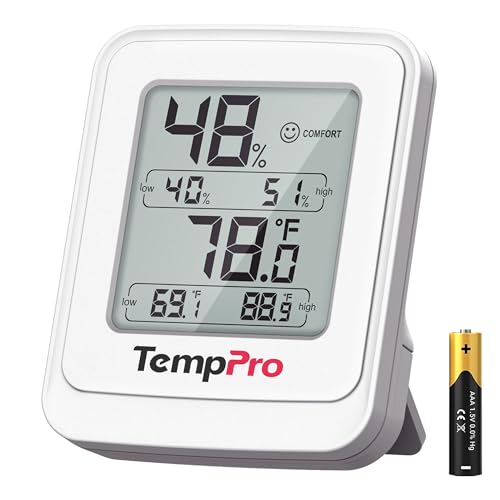
TempPro TempAir Digital Hygrometer Indoor Thermometer with IPX5 Waterproof | Greenhouse Thermometer Temperature and Humidity Monitor, High/Low Records Humidity Meter for Room Cellar Grow Tents Reptile
As an Amazon Associate we earn from qualifying purchases. Product prices and availability are accurate as of the date/time indicated.

DIGITEN Humidity Controller with Temperature Display for Reptile, Mushroom | Pre-Wired Digital Humidistat, Dual-Stage Outlet Humidifier/Dehumidifier for Grow Tent/Greenhouse, LCD Display, Plug & Play
As an Amazon Associate we earn from qualifying purchases. Product prices and availability are accurate as of the date/time indicated.
Prices shown are approximate and for reference only. Prices change often, so please check the current price on Amazon before you buy.
Accuracy classes summarize manufacturers’ published specifications for current versions; verify the exact model’s stated tolerance. Ratings are editorial, weighing accuracy and calibration options, logging and alerts, placement flexibility, build for humid service, and value.
The Six Grow Tent Hygrometers Reviewed
1. SensorPush HT1: Best Overall
The HT1 is the sensor the serious tent converges on: a small, sealed unit whose accuracy is the class reference, whose onboard memory logs for weeks between phone visits, whose app charts temperature and humidity together the way VPD thinking requires, and whose alerts arrive when the tent’s climate leaves the band you set, which is the moment a hygrometer earns the name instrument. It has no display, a philosophy this guide endorses for the tent, since the reading that matters is the trend on your phone rather than a number glimpsed through the door, and its optional gateway extends it to WiFi for the grower away from home. Its price is the premium of its sensor and its software, and across a sensor’s multi-year life it divides into pennies per crop. For one tent or five, it is the default this table defends.
2. Govee WiFi Thermo-Hygrometer: Best Remote Monitoring
Govee’s WiFi models answer the grower’s specific anxiety, the tent alone at home while life happens elsewhere: readings and alerts anywhere the phone has signal, app logging and export for the grow journal, and accuracy in the respectable class at a price under the leader’s. Its ecosystem’s breadth, lights and plugs and sensors in one app, suits the grower already living in it. Its disciplines are WiFi’s own: it wants a stable 2.4GHz network, its battery appetite is the connected class’s, and its sensor should still be salt-tested like every instrument in this article, a ritual Govee’s app calibration offset supports. For the commuter, the traveler, and the grower whose tent is in a detached space, it is the peace of mind row, honestly graded.
3. Inkbird IBS-TH2: Best Probe Flexibility
Inkbird is the grow community’s own brand, and the TH2’s probe versions embody its practicality: the sensing tip goes to the canopy on its cable while the body and its Bluetooth radio live in kinder air, the placement doctrine in this guide rendered as a product. Its app logs and alerts in the class’s standard, its price is the community’s favorite kind, and its accuracy, salt-tested and trimmed where the model allows, serves a tent well. Its software polish trails the leaders’, a cosmetic tax its owners pay gladly for the probe and the price. For the grower whose tent geometry defeats a one-piece sensor, and for the multi-zone tent that wants probes at two heights, it is the flexible answer.
4. ThermoPro TP49: Best Budget In-Tent Display
The TP49 is the household hygrometer that tents adopt by the thousand: a clear display readable through the tent door’s window, temperature and humidity with their highs and lows, a magnet for the tent’s frame or the fridge’s new career, and a price that makes buying two, canopy and corner, a rounding error, which is this guide’s placement doctrine at its most affordable. Its accuracy is the budget class’s, to be salt-tested and its offset remembered or written on its back in pencil, a humble ritual that converts it from an estimate into an instrument. It logs nothing and alerts no one, and for the grower who reads the tent daily in person, it covers the need with a decade’s reliability behind its brand. Every tent should own at least this much truth.
5. SwitchBot Meter Plus: Best Display Plus Smart Home
The Meter Plus splits the difference between the display and the data schools: a large, legible screen on the unit for the glance through the door, Bluetooth logging and app charts behind it, and integrations into the smart home platforms that let the tent’s climate trigger the house’s automations, the humidifier’s smart plug above all, in the ecosystems that support it. Its accuracy sits in the respectable class, its battery life is the display class’s generous span, and its design is the tidiest in the table. For the grower whose home already speaks SwitchBot or the broader smart dialects, it is the hygrometer that joins the household rather than merely the tent, and its row is the automation-curious grower’s natural start.
6. AC Infinity’s Sensor Ecosystem: Best for Automated Tents
Where the tent already runs an AC Infinity controller, its own sensors are less a purchase than a completion: the wired probe reads at the canopy, the controller logs it beside the fan and light data, and the automations, exhaust responding to humidity, alerts at the band’s edge, close the loop that the standalone hygrometers only report on. Graded as a hygrometer alone it is a fine, accurate probe; graded as a system it is the end state this article’s other rows gesture toward, measurement married to response. Its boundary is its ecosystem, the probe speaks to its own controllers, and the grower outside that world should buy the rows above. Inside it, the question is not whether but how many zones, which is the automated tent’s version of this guide’s two-sensor doctrine.
Buying Guide: How to Choose the Best Hygrometer for Your Grow Tent
Step One: Decide What the Reading Must Do
Sort yourself by the decision the number drives. The grower who checks the tent in person daily and adjusts by hand needs honest accuracy and a readable display or app, the TP49’s and SensorPush’s shared floor. The grower whose tent must report its failures, the humidifier’s empty tank at noon, the exhaust’s stumble in a heatwave, needs logging and alerts, which moves the purchase to the connected rows and makes the alert thresholds a setup step as important as the sensor’s placement. The grower building toward automation should buy inside the controller ecosystem they intend to end in, because sensors are the automation’s senses and mixed ecosystems rarely marry. Write the decision the number drives at the top of the shopping list, and let it filter the table before price does, since a cheap sensor that cannot alert is expensive in the currency of the crop it watched drift.
Step Two: Salt-Test It the Week It Arrives
Commission the instrument before trusting it, with the sealed-jar salt test this guide described: a bottle cap of table salt wetted to a slurry, sealed in a bag or jar with the sensor for eight to twelve hours, against the known reference of roughly seventy-five percent humidity at room temperature. Note the error, apply the calibration offset if the model offers one, or write the correction on the unit and in the grow journal if it does not, and repeat the test each season or after any reading that contradicts the plants’ own testimony, because the plants are the second instrument and a disagreement between leaf and sensor is a calibration appointment, not an argument. Keep a second, independent sensor in the tent for the first cycle with any new primary, the two-sensor doctrine in its commissioning form, and retire or demote the unit whose drift will not trim. This hour of ritual is what separates the growers who know their climate from the growers who know their display.
Step Three: Place It, Log It, and Steer by Trends
Hang the sensor at canopy height in shaded, moving air by this guide’s placement rules, and give the system a full day before judging it, since a tent’s climate has a daily rhythm that a single reading misrepresents as surely as a single photograph misrepresents a plant. Then steer by the log rather than by the glance: the overnight lows where mold plots, the lights-on spike where the exhaust earns its keep, the humidifier’s duty cycle across a tank, patterns that exist only in the chart and that decide the adjustments that actually work, a vent’s timing, a humidifier’s size, a controller’s band. Recheck placement whenever the canopy grows into the sensor’s neighborhood, which in a vigorous tent is monthly, and keep the sensor’s own environment honest, out of the nutrient splash zone, its vents unblocked by the leaf that grew over it in the night. A hygrometer placed, calibrated, and read as a trend is the tent’s climate made visible, and a visible climate, in this hobby, is nine-tenths of a controlled one.
Frequently Asked Questions About Hygrometers for Grow Tents
How accurate does a grow tent hygrometer need to be?
Within two to three humidity points across the growing range is the working standard this guide buys by, because the decisions the number drives, humidify, exhaust, hold, are made in bands several points wide, and a sensor inside that tolerance steers them correctly. The danger is not the sensor that reads two points high, which shifts every decision by the same harmless margin, but the one that drifts, reads five low in the flowering band where mold makes its home, or disagrees with itself between morning and night. Hence the guide’s twin insistence on a documented accuracy class at purchase and the salt test across the sensor’s life: buy the tolerance, then verify it like a scale in a shop that weighs money. The bargain sensors are not forbidden by this standard; they are on probation under it, admitted to the tent when their salt test passes and demoted to the drying rack’s rough duty when it stops passing.
Where exactly should I hang the hygrometer in my tent?
At the canopy’s height, in the plants’ own air, shaded from the light’s direct radiation and clear of the humidifier’s plume and the intake’s stream, which usually means hanging from the tent’s frame or a plant tie at the canopy’s edge, a few inches above the leaves, where the air moves gently. Avoid the corners’ dead air for the primary reading, avoid the exhaust’s neighborhood, whose air is the tent’s average leaving rather than the plants’ present, and avoid resting the sensor on any surface that conducts the light’s heat or the reservoir’s cool. In tents over a certain size, and in any tent during its first cycle under your care, run the second sensor in the far corner for a season and learn the gradient between them; thereafter the canopy sensor is the record and the corner’s number, if you keep it, is the early warning. Move the sensor up as the canopy rises, because a sensor the plants have grown past is measuring last month’s climate at last month’s height.
What humidity should my grow tent be at each stage?
Answer in VPD’s language where you can and in humidity bands where you must, always paired with your temperature, because the same percentage is a different climate at different warmth. As broad orientation rather than prescription: germination and clones live wettest, commonly in the seventy percent neighborhood and above; vegetative growth settles into the moderate band, roughly fifty to seventy percent at typical tent temperatures; flowering asks progressively drier air, commonly forty to fifty-five percent, as the mold risk in dense flowers outranks the growth the humidity buys; and drying is its own discipline around the high fifties to low sixties, slowly, in the dark. Your crop’s and cultivar’s guidance refines those bands, your VPD chart converts them honestly at your tent’s temperature, and your hygrometer’s log tells you whether the tent obeyed. Treat any source that gives you one humidity number for all stages and all temperatures the way this guide treats a pump’s headline GPH: as marketing’s weather, not the field’s.
My hygrometer and my controller disagree. Which do I trust?
Neither, until the salt test arbitrates, which is why this guide builds the ritual into the purchase. Two sensors disagreeing by two or three points are both within their classes and the disagreement is the sound of tolerances overlapping; steer by the one placed at the canopy, and note the offset in the journal so the controller’s automations can be set with the difference understood. A disagreement beyond five points is a finding, not a nuisance: pull both, salt-test both side by side, and the jar will name the drifter, which is then calibrated, demoted, or replaced by its result. Controllers add one wrinkle, their probes age in the tent’s weather exactly as standalone sensors do, so the arbitration applies to them on the same seasonal schedule. The deeper lesson is the guide’s closing one: a single unverified number is an opinion, two agreeing instruments are a measurement, and the grower’s climate is only ever as honest as the last time they checked it against a truth they made in a jar.
Related guides
- Hydroponic Lettuce vs Soil Lettuce Growing in 2026: Speed, Taste, Cost, and Which System Fits Your Tent, Counter, and Budget
- Best Grow Tent for Dry Climate Growing in 2026: Tents That Hold Humidity, Seal Tight, and Keep VPD in Range in Arid Rooms
- Best Size Aquarium for Full Grown Bearded Dragon in 2026: 6 Aquariums and Terrariums From 40 to 120 Gallons, With a Size of at Least 48 x 24 x 24 Inches, and a Price Range, for a Full Grown Bearded Dragon
- Best pH Meter vs Test Strips Growing in 2026: How to Pick a pH Meter vs Test Strips for Growing That Gives Accurate Readings, Is Easy to Use, and Works for Your Vegetables and Herbs
More from Amazon
Programs that pair well with the guide above. Offers and eligibility are set by Amazon and may change.
Free shipping on eligible items, Prime Video and more. Eligible new members can start with a free trial.
Start a Prime free trialAudiobooks and podcasts to listen to on the go. Eligible new members can start with a free trial.
Try Audible freeAd-free music streaming. Eligible new subscribers can start with a free trial.
Try Music Unlimited freeA free business account with business pricing and bulk-buying tools for work, shop or home office.
Create a business accountAs an Amazon Associate we earn from qualifying purchases.

Write Your Review
No reviews yet. Be the first to share your experience!