
What's inside
As an Amazon Associate I earn from qualifying purchases. This post may contain affiliate links at no extra cost to you.
Learning how to choose trellis net size sounds like a small decision until a grower is standing in front of a tent with a net that is six inches too short on every side, a mesh so wide the branches slide through it, or a roll of netting long enough for a warehouse and no clean way to cut it without fraying it into the canopy. A trellis net, often used as a screen of green or ScrOG net indoors, does three jobs at once: it spreads branches horizontally so the canopy becomes even, it supports stems and heavy tops later in the cycle, and it creates a fixed reference height that makes training decisions repeatable from run to run. Choosing its size is therefore not one measurement but three: the net’s overall dimensions against your tent or bed, the mesh opening size against your plant’s stems and your training style, and the number and height of layers against the way your crop grows. Get those three right and the net disappears into the grow as quiet infrastructure. Get one wrong and you will fight it every day of the cycle.
Start with the space, measured honestly. Measure the inside of your tent or the inside edges of your raised bed or tray, not the nominal size printed on the tent box. A tent sold as a certain size can have poles, corners, ducting, and equipment that reduce the usable canopy footprint, and a net should span the area the plants will actually occupy, with a small margin for attachment, not the largest rectangle that can be forced into the frame. Most indoor trellis nets are sold in tent-matched sizes and in larger rolls or sheets that are cut to fit. Elastic nets with hooks suit standard tent sizes and forgive small measurement errors because they stretch to the poles. Cut-to-fit netting suits odd beds, DIY frames, and growers who want an exact span, but it transfers the measuring responsibility entirely to you. In both cases, plan how the net attaches before you buy it: to tent poles with hooks or clips, to a PVC or timber frame you build for a bed, or to the bed’s own posts. A net without a planned attachment point every reasonable interval will sag in the middle, and a sagging net trains a sagging canopy.
Mesh size is the decision beginners most often get wrong, because both extremes feel plausible. Very wide mesh, in the range sold for peas, beans, and heavy outdoor climbers, lets indoor branches pass through without being held, so the canopy escapes upward in the center and the net becomes decoration. Very tight mesh can be hard to weave branches through without snapping tips, hard to clean between runs, and hard to harvest through without cutting the net away. For most indoor canopy training, a moderate square mesh is the working answer: openings large enough to pass a growing tip through by hand, small enough that each branch is genuinely held and can be tucked to a new square as it grows. The exact size that suits you depends on stem thickness, how aggressively you train, and whether the net’s primary job is spreading, supporting, or both. A support net for tall, heavy plants late in their cycle can be wider than a training net used from early growth, which is one reason experienced growers often run two layers with different jobs rather than asking one net to do everything.
Layers and height complete the size decision. A single layer, set at the height where you want the canopy to flatten, is the classic training screen: plants grow up through it, are tucked back under or across as they stretch, and emerge as an even top. A second layer, set above the first, is a support layer: it does not train so much as catch, holding heavy branches upright and apart as weight builds. The distance between layers and between the pots, lights, and net should be planned from your plant’s expected height and your light’s required distance to the canopy, following your light maker’s guidance. A net set too low leaves no room to work under the canopy or to manage airflow beneath it. A net set too high lets plants become tall and unruly before they ever reach their training reference. Growers working with legally permitted plants should also keep their whole setup compliant with local law, manage water and electrics with the usual indoor-growing separation and protection, and keep nutrients, tools, and harvested material stored safely away from children and pets.
This guide explains the sizing decisions in order, then compares six real, currently sold trellis options that represent the market: AC Infinity trellis net classes, Vivosun elastic and cut trellis classes, Mars Hydro and Spider Farmer tent-matched net classes in their accessory lines, generic heavy-duty nylon trellis rolls from established garden suppliers such as Gardener’s Supply-class retailers, and hydroponic-store cut netting classes. Confirm the exact product’s stated overall size, mesh size, material, and attachment method before buying, because trellis names are vague and the numbers are the product.
How to Choose Trellis Net Size by Tent, Mesh, and Layer
Overall size: span the canopy, not the catalogue
Measure the inside width and depth of the growing area at the height where the net will sit, because tents can taper, beds can bow, and equipment can intrude differently at canopy height than at the floor. For an elastic tent net, choose the size the maker lists for your tent class and confirm its stretched and unstretched dimensions if they are stated; an elastic net stretched to its limit will pull hard on poles and sag less, but it will also pull branches with more force and can distort a light tent frame. For a cut sheet or roll, add a working margin for tying, clipping, or wrapping at the edges, and cut with a method that suits the material, sealing synthetic cut ends as the maker or common practice for that material directs so they do not unravel into the crop. Lay the net out flat before installation day. A net first untangled above a living canopy teaches patience no grower asked for.
Mesh size: hold the branch, pass the hand
Test the idea with your own plants in mind. A growing tip and your fingers must pass through the opening repeatedly without damage, because training is a repeated act across weeks, not a single threading. A mature stem and a heavy top must be held by the opening without sliding sideways or sawing against a thin cord under load. Thin string nets are gentle and cheap but can cut into soft stems when heavily loaded and are often treated as single-run consumables. Woven or elastic webbing nets are kinder to stems and reusable, at a higher price and with mesh sizes that may be fixed by the product’s design. Nylon and polyester nets resist rot and are easy to clean; natural fiber nets suit some outdoor and soil philosophies but can degrade in a humid indoor cycle and are harder to sanitize between runs. Choose the material for your hygiene system, because a net that cannot be cleaned will eventually be a net that should not be reused.
One layer or two: training versus support
Decide the net’s job before deciding its count. If your plants are trained early and kept compact, one well-placed training layer may be the entire system. If your plants stretch significantly or carry heavy fruit or flowers, plan the second support layer from the start, including its attachment points and height, rather than trying to thread a net over a finished canopy, which is one of indoor growing’s genuinely miserable tasks. Leave yourself access: a net that spans wall to wall with no thought for reaching the back plants will be cut, climbed, or resented. Some growers leave a service gap at one side or use a net size that covers the main canopy while preserving a working lane, accepting slightly less training at the edge in exchange for being able to water, inspect, and harvest like a person.
Quick Comparison: Trellis Net Sizes and Models
| Model | Key Specs | Best For | Typical Price Range | Rating |
|---|---|---|---|---|
| AC Infinity Trellis Net Classes | Elastic tent-matched classes as maker states by tent size, mesh classes, hook classes, reusable classes | Best how to choose trellis net size tent pick overall | $15 – $30 by tent size | 4.6 / 5 |
| Vivosun Elastic Trellis Classes | Elastic classes by tent size as maker states, hook classes, mesh classes, value classes | Best value elastic net | $10 – $25 by size | 4.3 / 5 |
| Vivosun Cut-to-Fit Trellis Rolls | Roll and sheet classes as maker states, mesh classes, cut-to-size classes, material classes | Best for beds and odd sizes | $12 – $30 by roll size | 4.3 / 5 |
| Mars Hydro and Spider Farmer Net Classes | Tent accessory net classes by brand and tent size as maker states, elastic and hook classes | Best matched to house tents | $12 – $28 by size | 4.2 / 5 |
| Heavy-Duty Nylon Garden Trellis Rolls | Large roll classes as supplier states, wide mesh classes, outdoor and indoor classes, cut classes | Best for large support layers | $15 – $40 by roll size | 4.2 / 5 |
| Hydro Store Bulk Netting Classes | Bulk cut classes by width as retailer states, mesh classes, frame classes, commercial classes | Best for DIY frames | $10 – $35 by cut size | 4.1 / 5 |
Overall dimensions, mesh opening size, material, elasticity, and included hooks are each maker’s specification for the current exact product; mesh sizes are stated differently across brands, so compare the opening measurement, not the product name. Prices are typical street ranges. Ratings reflect sizing clarity, attachment sense, stem kindness, reusability, and value.
Detailed Reviews: Trellis Nets by Size and Job
1. AC Infinity Trellis Net Classes – Best Tent Pick
AC Infinity’s accessory approach suits tent growers because the nets are sized to tent classes, elastic enough to install without a construction project, and built to be reused across runs with cleaning. For a grower whose question is simply which net fits a standard tent and works, this is the lowest-friction answer in the table.
Elasticity is both the feature and the limit. On a tent at the large end of a net’s stated range, tension will be high and the pull on poles real; on a smaller fit, the net may not tension enough to train firmly. Match the size class carefully rather than stretching one net across two different tents and blaming it for both results.
2. Vivosun Elastic Classes – Best Value Elastic
Vivosun’s elastic nets give the same tent-matched convenience at a lower price, which suits growers running several tents or replacing nets more often for hygiene. In a multi-tent room, standardizing on one net system simplifies spares, hooks, and the mental model of where a canopy should sit.
Inspect hooks and elastic on arrival and between runs. A stretched-out elastic net that no longer holds tension has finished its service, and retiring it on time is cheaper than retraining a canopy that escaped through a tired net.
3. Vivosun Cut-to-Fit Rolls – Best for Beds and Odd Sizes
A roll is the correct product when the growing area is not a standard tent: a raised bed, a tray on a rack, a DIY frame, or a tent whose usable footprint has been reduced by equipment. You trade installation time for an exact span and the ability to cut a second, wider-mesh support layer from the same material family.
Measure twice, mark the cut on a flat floor, and finish the edges so they do not fray. Keep the offcuts: a small piece of netting repairs a section, ties a branch, or becomes the test piece for your cleaning method before you commit the whole net to it.
4. Mars Hydro and Spider Farmer Net Classes – Best Matched Accessories
House accessory nets from tent brands make sense when you want the net, hooks, and tent to have been considered together, and when you value buying spares from the same source as the tent. Their quality sits in the honest accessory class: not a lifetime tool, but a correct fit with minimal research.
Confirm the mesh opening measurement rather than assuming two brands mean the same thing by a similar product photo. In trellis netting, a photograph cannot tell you the one number that decides whether your branches are held.
5. Heavy-Duty Nylon Garden Rolls – Best Support Layers
Garden-supply nylon rolls, sold for outdoor climbers and crop support, become indoor support layers very effectively: strong, wide-meshed, cheap per square meter, and easy to cut for a second layer whose only job is to hold weight. For tall plants and heavy tops, that division of labor — a kinder training net below, a strong support net above — is how many experienced growers stop asking one product to be two.
Wide mesh is wrong for early training, so do not let a bargain roll become your only net by accident. Label the layers by job when you store them, because in a drawer all netting looks alike and in a tent the difference is the crop.
6. Hydro Store Bulk Netting – Best for DIY Frames
Bulk netting cut by a hydroponic retailer suits growers building frames to exact room dimensions, running larger indoor beds, or replacing netting on a schedule for hygiene in a serious room. The value is in the cut and the mesh choice, bought by specification rather than by brand story.
DIY transfers quality control to you: frame rigidity, attachment spacing, and edge finishing are your workmanship. Build the frame before the plants need it, at a height you can adjust, because adjusting a loaded net is a two-person job that should never be scheduled for the first time in flower or fruit.
Buying Guide: How to Choose Trellis Net Size
Measure in the right order
First, measure the inside of the tent or bed at canopy height and write down width, depth, and any intrusions. Second, decide the attachment method and points, and add the margin that method needs. Third, choose the mesh opening by your plants’ stems and your training intensity, preferring a moderate training mesh for a first net. Fourth, decide one layer or two by the plant’s expected stretch and final weight, and plan both heights before the run starts. A net bought in that order fits. A net bought by a product photo is a surprise with hooks.
Match net height to light, access, and plant height
Plan the training layer where you want the canopy to flatten, leaving working room beneath it for watering, airflow, and inspection, and leaving the light’s required distance above the finished canopy, per your light maker’s guidance. Plan the support layer where heavy branches will need catching, not where it is convenient to install after the fact. If your tent is short, be especially honest: a net, a tall plant, and a light all compete for the same vertical meters, and the net loses if it is planned last.
Decide reuse or replace, and clean accordingly
A reusable net should be cleaned between runs by a method its material tolerates, inspected for stretched sections, broken strands, and tired hooks, and stored dry and untangled. A low-cost string net may be more honestly treated as a single-run consumable, cut away at harvest, which also solves the harvest problem in a dense canopy. Either system is defensible; drifting between them — reusing a net that cannot be cleaned, in a room with any history of pests or disease — is not. When in doubt after a problem run, replace the net. It is one of the cheapest hygiene decisions in the tent.
Keep the system safe and lawful
Keep netting and its frames clear of fans, lights, and heaters except as each product is designed to be used, keep water and nutrient reservoirs away from electrical equipment, and use appropriate electrical protection for the room as a whole. Grow only what you are legally permitted to grow where you are, follow local rules for indoor cultivation, and store all growing inputs and outputs securely away from children and pets. A well-sized net is a small part of a well-run room, and the room’s disciplines are what make the net’s work possible.
Net Options for Indoor Canopy Support
A good net holds stems up without stressing them. These come in sizes that fit common tent footprints.
VIVOSUN 5×5 Elastic Trellis Netting
A stretchy net with four hooks for a larger tent. Elasticity lets stems move as they grow.
As an Amazon Associate we earn from qualifying purchases at no extra cost to you.

Elastic Trellis Net, 2×4 Two-Pack
Two nets sized for a 2×4 tent. Use one now and keep the second as a spare.

BSTPCOO 2×2 Elastic Trellis Net
A smaller net sized for a 2×2 tent. Comes with hooks, so installation is quick.
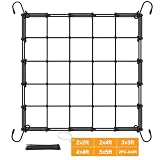
VIVOSUN Heavy-Duty Polyester Trellis, 5×30 Feet
A rigid polyester roll you can cut to size. Better for beds and odd-shaped spaces.

Frequently Asked Questions About How to Choose Trellis Net Size
How do I choose trellis net size?
Measure the inside of your tent or bed at canopy height, choose a net that spans the plant area with the margin your attachment method needs, pick a moderate mesh opening that passes your fingers and growing tips while genuinely holding a mature stem, and decide whether you need one training layer, a second wider support layer, or both. Tent-matched elastic nets such as the AC Infinity and Vivosun classes are the easiest route for standard tents, while cut-to-fit rolls suit beds and DIY frames. Plan the layer heights against your plant’s expected height and your light’s required canopy distance before the run begins.
What mesh size is best for a ScrOG or training net?
For most indoor training, a moderate square mesh is the working choice: large enough to tuck and re-tuck growing tips by hand without snapping them, small enough that each branch is held in its assigned square as the canopy flattens. Very wide mesh suits a later support layer for heavy plants, and very tight mesh makes training, cleaning, and harvest harder than they need to be. Compare the stated opening measurement between products rather than trusting names or photographs, and consider your stem thickness: delicate, thin-stemmed plants want a gentler, kinder net surface, while heavy, woody growth can use a stronger, wider support net above the training layer.
Should I use one trellis net or two?
Use one training layer if your plants are kept compact, trained early, and do not carry heavy tops that need catching. Use two layers if your plants stretch significantly or set heavy fruit or flowers: a training net at the height where the canopy flattens, and a support net above it, installed or at least planned before the canopy closes. Trying to add a support net over a finished, loaded canopy is difficult and damages plants, so the two-layer decision belongs at the start of the run. Leave yourself a way to reach the back of the canopy in either system, even if it means a small service gap at one edge.
Can I reuse a trellis net for the next grow?
Yes, if it is a reusable material in good condition and you clean it thoroughly between runs, inspect it for stretched or broken sections and tired elastic or hooks, and store it dry and untangled. Replace it after any run with pest or disease problems you cannot be confident cleaning has resolved, and treat low-cost string netting as a single-run consumable that is cut away at harvest. A net is inexpensive compared with a crop, so when its condition or hygiene is in doubt, replacement is the professional decision. Keep a spare net in the room’s supplies so that decision never has to wait for a delivery.
Related guides
- Best LED vs Fluorescent Grow Light Growing in 2026: 6 Top LED and Fluorescent Grow Lights, Bright Growth, and Easy Growing
- 200W LED vs 400W LED Grow Light in 2026: Which Size Is Best for Your Grow Tent?
- Best Meter for Hydroponic Water Testing in 2026 for Healthy Plants, Accurate pH, and Choosing the Best Meter for Hydroponic Water Testing
- Best LED Light for Growing Basil in Windowless Kitchens in 2026: 7 LED Grow Lights That Grow Basil Without a Window, Without a Big Tent, and Without a High Electric Bill
More from Amazon
Programs that pair well with the guide above. Offers and eligibility are set by Amazon and may change.
Free shipping on eligible items, Prime Video and more. Eligible new members can start with a free trial.
Start a Prime free trialAudiobooks and podcasts to listen to on the go. Eligible new members can start with a free trial.
Try Audible freeAd-free music streaming. Eligible new subscribers can start with a free trial.
Try Music Unlimited freeA free business account with business pricing and bulk-buying tools for work, shop or home office.
Create a business accountAs an Amazon Associate we earn from qualifying purchases.

Write Your Review
No reviews yet. Be the first to share your experience!