
What's inside
As an Amazon Associate I earn from qualifying purchases. This post may contain affiliate links at no extra cost to you.
The best nutrients for hydroponic lettuce growing succeed by restraint, because lettuce is the modesty of the hydroponic garden made edible: a fast, leafy crop that finishes in a month, wants a gentle nutrient solution roughly half the strength a fruiting plant demands, burns at its leaf tips when the salts climb, and rewards the grower who feeds it steadily and lightly with heads that are sweet, crisp, and unmarked. The beginner’s instinct, to feed lettuce like a tomato, is the crop’s most common injury, and the nutrient shelf is full of strong general formulas whose labels must be read at half strength to suit it. This guide compares six real, currently sold nutrient systems graded for lettuce specifically: the balance of nitrogen to potassium to calcium that leafy growth consumes, the working strength the crop prefers, the pH behavior in a recirculating reservoir, and the cost per reservoir that makes a salad habit economical. Its doctrine is stated once and applied throughout: lettuce grows on an electrical conductivity, EC, roughly between 0.8 and 1.2 in most systems, a pH held between about 5.5 and 6.5, cool solution, and consistency, and the best nutrient product is the one that makes holding those numbers easy for the grower’s particular setup, from a countertop raft to a garage NFT wall.
Understand what lettuce actually eats before the table. A leaf is mostly nitrogen’s work, so the formula leans nitrogen-forward in its vegetative balance, but potassium runs the plant’s water economy and calcium builds the cell walls whose failure appears as tipburn, the brown, papery leaf edges that ruin a head’s looks and most often trace not to a lack of calcium in the reservoir but to its failure to reach the leaf, a transport problem of humidity, airflow, and growth speed that no nutrient label can fully cure. Iron and the micronutrients ride along in any complete formula, and magnesium, the Epsom salt of the classic dry recipes, completes the macronutrient parish. The reservoir adds the system’s variables: as lettuce drinks, water leaves faster than salts or the reverse depending on the room, so the EC drifts, the pH wanders as the plant’s own feeding changes the solution’s balance, and the grower’s instruments, a pH pen and an EC meter, kept calibrated, are as much a part of the nutrient system as anything in a bottle. Read every product in the table against that reality: a nutrient for lettuce is a tool for holding a gentle, stable solution steady for thirty days, and it is graded on how gracefully it does exactly that.
Our Top Picks
Best Nutrients for Hydroponic Lettuce Growing: EC, pH, and Tipburn
The Lettuce Numbers: Gentle Strength, Cool Roots, Steady pH
Commit the crop’s working ranges to the reservoir’s wall. Young seedlings start weakest, a quarter to a half strength solution, rising as the true leaves establish to the adult working band around EC 0.8 to 1.2, the lower end for warm rooms and butterheads, the upper for cool conditions and hungry romaines, with the grower watching the plants’ color and pace as the final arbiter the numbers serve. The pH lives between about 5.5 and 6.5 with the sweet parish near 5.8 to 6.2, checked every day or two in a recirculating system because lettuce’s own feeding pushes it steadily, and corrected in small nudges rather than heroic swings. Solution temperature is the silent variable: lettuce is a cool-season crop to its roots, thriving with the reservoir in the 60s Fahrenheit and sulking as it climbs into the mid-70s, where dissolved oxygen falls, root diseases find their invitation, and the crop’s bitterness begins. A nutrient program that ignores temperature is a recipe missing its oven setting, which is why this guide’s buying steps end at the reservoir’s thermometer as often as at its bottles.
Tipburn: The Calcium Story Told Honestly
Give tipburn its own heading because it is the lettuce grower’s signature sorrow and its most misunderstood. The symptom is a failure of delivery, not usually of supply: the inner leaves of a fast-growing head are the last served by the plant’s water stream, and on the humid, still days when transpiration slows, calcium, which travels only with that stream, arrives too late for the leaf edges’ construction schedule. The cures therefore live mostly outside the bottle: airflow across the canopy day and night, humidity managed so the plant keeps drinking, growth kept steady rather than forced by high EC, and varieties chosen for resistance where the grower’s conditions are chronic. The nutrient’s honest contribution is a formula that carries adequate calcium from the start, which the complete systems and the classic dry recipe of this table all do, and a grower who responds to tipburn by pouring in more calcium additive while the air sits still is treating the wrong system. Grade the products on complete, balanced calcium in the base formula, and grade yourself on the fan.
Liquid Systems vs Dry Salts: Convenience Against Cost
The format question divides the table’s economics. The liquid systems, the famous three-part and one-part bottles, sell convenience and consistency: pre-dissolved, pH-buffered to a degree, mixed by the capful, ideal for the small reservoir and the new grower, at a cost per gallon of solution that the dry parish finds theatrical. The dry salts, MasterBlend’s classic three-ingredient recipe above all, sell the opposite virtues: pennies per reservoir, a formula the grower composes and therefore understands, shelf life measured in years, at the price of a scale, a mixing ritual, and three stock solutions kept in order. Neither is the correct answer outside the grower’s scale: the countertop raft drinks so little that the liquids’ premium is a rounding error, while the garage wall’s weekly reservoir changes make the dry recipe’s savings a genuine line in the household budget. The table grades both parishes on their own terms, and the buying guide’s first step is the reservoir’s size, from which the format largely elects itself.
Best Nutrients for Hydroponic Lettuce Growing: Quick Comparison
| Nutrient System | Key Specs | Best For | Typical Price Range | Rating |
|---|---|---|---|---|
| General Hydroponics Flora Series (3-part) | Liquid 3-part in class, adjustable ratios positioning, the hydroponic standard | Best nutrients for hydroponic lettuce growing overall | $35 – $55 per quart trio | 4.7 / 5 |
| MasterBlend 4-18-38 + Calcium Nitrate + Epsom Salt | Dry 3-ingredient recipe in class, lettuce-formula heritage positioning, lowest cost per gallon | Best value and large systems | $25 – $45 per multi-lb kit | 4.7 / 5 |
| General Hydroponics FloraNova Grow (1-part) | Liquid 1-part in class, concentrated positioning, simple dosing | Best simple liquid for small systems | $20 – $35 per quart | 4.5 / 5 |
| Dyna-Gro Foliage-Pro (9-3-6 class) | Liquid 1-part in class, high-nitrogen leafy ratio positioning, complete with calcium in line | Best ratio for leafy greens | $15 – $28 per bottle by size | 4.5 / 5 |
| Botanicare Pure Blend Pro Grow | Liquid in class, organic-based positioning, gentle feeding class | Best organic-leaning option | $20 – $35 per quart | 4.3 / 5 |
| General Hydroponics MaxiGro (dry 1-part) | Dry 1-part powder in class, scoop dosing positioning, economical | Best dry convenience | $15 – $25 per pouch | 4.4 / 5 |

Liquid Plant Food – Hydroponics Nutrients for Indoor House Plants, Tomato, Strawberry, Lucky Bamboo, Lettuce, Vegetable Garden & Herbs – Aero Nutrients Liquid Fertilizer for All Growing Systems (8 oz)


As an Amazon Associate we earn from qualifying purchases. Product prices and availability are accurate as of the date/time indicated.

Kratky Hydroponic Fertilizer, Liquid Plant Food for Strong Growth, 8 oz | Supports Passive Growing, Stable Reservoir Formula, For Lettuce, Herbs & Greens, Easy Mix Ratio, Liquid Concentrate
As an Amazon Associate we earn from qualifying purchases. Product prices and availability are accurate as of the date/time indicated.
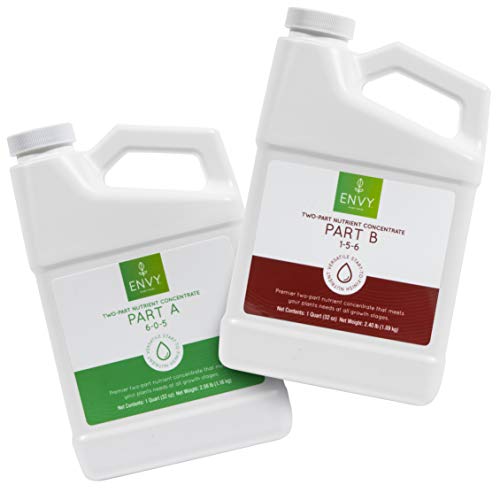
ENVY Hydroponic Plant Food A & B – Two-Part Liquid Nutrient for Indoor/Outdoor Plants – Soil, Coco, Hydroponics, DWC – Quart Set
As an Amazon Associate we earn from qualifying purchases. Product prices and availability are accurate as of the date/time indicated.
Prices shown are approximate and for reference only. Prices change often, so please check the current price on Amazon before you buy.
Always dose lettuce at reduced strength per the article’s EC guidance rather than full label rates written for heavier feeders. Prices are typical US street ranges. Ratings are editorial for hydroponic lettuce, weighing nutrient balance for leafy growth, pH and EC behavior, ease of use, and cost per reservoir.
The Six Lettuce Nutrient Systems Reviewed
1. GH Flora Series: Best Overall
The three-part Flora system leads on control: grow, bloom, and micro bottles composed to the crop’s week, so lettuce rides the vegetative ratio from seedling to harvest with the calcium carried in the micro as designed. Its ritual is the hobby’s standard education in a box. For the grower who will expand beyond lettuce, it is the recommendation defended first, and for lettuce alone it remains the benchmark.
2. MasterBlend Recipe: Best Value
The MasterBlend trio, tomato formula by birth and lettuce legend by adoption, mixes at the classic proportions with calcium nitrate and Epsom salt into the cheapest complete solution in this table, stable and proven across a generation of raft and NFT houses. It asks a scale and a ritual. At any scale beyond the countertop, its economics are not an argument but a landslide.
3. FloraNova Grow: Best Simple Liquid
FloraNova compresses the liquid parish into one shaken bottle, concentrated enough that a quart serves a small system for seasons, dosed by the teaspoon toward the article’s gentle EC. Its thickness demands a thorough shake and a rinse of the measuring spoon. For the countertop and the beginner, it is convenience without surrender.
4. Dyna-Gro Foliage-Pro: Best Leafy Ratio
Foliage-Pro’s high-nitrogen ratio was composed for exactly this crop’s parish, leaves, and its completeness, calcium and magnesium in the base, suits the small grower who wants one bottle and no additives shelf. Its dosing for lettuce runs light against the label. In the one-bottle league it is the ratio purist’s choice.
5. Botanicare Pure Blend Pro Grow: Best Organic-Leaning
Pure Blend Pro brings an organic-based formula to a crop whose eaters often ask, gentle in character and well suited to the Kratky and raft parishes. Its behavior in long recirculating runs asks the reservoir’s closer attention. For the grower whose values include the input list, it is the credible row.
6. GH MaxiGro: Best Dry Convenience
MaxiGro is the dry parish with the ritual removed: one powder, one scoop, complete feeding at a cost per reservoir near the MasterBlend end of the ledger. Its single ratio is the compromise its convenience is priced on. For the mid-size system that wants dry economics without three stock bottles, it closes the table exactly where it should.
Buying Guide: How to Feed Hydroponic Lettuce
Step One: Let the Reservoir’s Size Choose the Format
Measure the system’s appetite first: the countertop raft and the small DWC tote drink a few gallons a month, and the liquid systems’ convenience is worth more than the dry recipe’s savings at that scale; the NFT wall and the Dutch bucket parish turn over tens of gallons, where the dry salts’ pennies-per-gallon become the household’s real money across a year. Confirm the instruments in the same step, since no nutrient in this table can be run honestly without them: a pH pen and an EC meter, with calibration solutions for both, are part of the nutrient purchase and should be budgeted as such, the pair costing what a bottle costs and outlasting a shelf of them.
Step Two: Mix to the Lettuce Numbers, Not the Label’s Ambition
Mix the first reservoir to the article’s working band, seedlings at quarter to half strength, established plants toward EC 0.8 to 1.2, adding nutrients to water in the maker’s prescribed order, calcium-bearing parts kept from meeting concentrates undiluted, and the whole stirred and rested before the pH is read and adjusted in small steps toward the high 5s. Record the recipe that produced the target numbers in your water, since your tap’s starting mineral content makes your reservoir’s arithmetic your own, and the log written once saves a season of re-derivation. Top up with plain water as the level falls between changes, correcting the full solution on the reservoir change rhythm your system size dictates, weekly to fortnightly for most home recirculators.
Step Three: Read the Plants and Keep the Roots Cool
Run the crop as a feedback loop: pale, slow growth argues the EC upward a step; dark, brittle leaves and burned tips argue it down; the pH is checked on the round of visits and nudged, never chased; and the solution’s temperature is guarded like a crop input, the reservoir insulated, shaded, or chilled toward the 60s as the room demands, since warm solution undoes good feeding faster than any formula can repair it. Keep the air moving across the canopy for tipburn’s sake, harvest outer leaves or whole heads on the crop’s quick clock, and replant on the succession rhythm that keeps the system never empty and never crowded. Kept so, the nutrient question dissolves into what it should have been all along: a small, steady routine behind a continuous supply of salads, each head costing cents of the formula in this table and tasting like the argument for the whole enterprise.
Frequently Asked Questions About Lettuce Nutrients
What EC and pH should hydroponic lettuce be grown at?
At the gentle numbers this article repeats because they are the crop: an EC roughly between 0.8 and 1.2 for established plants, lower for seedlings and lower still in hot rooms, and a pH between about 5.5 and 6.5 with the working sweet spot near 5.8 to 6.2. Treat the ranges as a parish rather than a point, since varieties differ in appetite, butterheads running lighter than romaines, and the water’s starting mineral content shifts what a given recipe delivers. The instruments decide: measure the reservoir rather than trusting the recipe’s arithmetic, adjust in small steps, and let the plants’ color and pace grade the numbers across the first crop, after which your own log, in your own water, outranks any chart, this one included. Consistency inside the band matters more than precision at its center, because lettuce forgives a steady 1.0 and resents a wandering 0.8-to-1.4 in the same week.
Can I use regular garden fertilizer for hydroponic lettuce?
Not honestly, and the reasons are chemistry rather than snobbery: soil fertilizers assume the soil itself supplies part of the diet, calcium and micronutrients among them, and they commonly carry nitrogen in forms, urea above all, that a recirculating solution handles poorly, while lacking the complete, immediately available balance a water crop, which has no soil to consult, requires in every feeding. The result is the classic beginner’s reservoir, deficient and excessive at once, with algae farming the surplus. Hydroponic nutrients, every row of this table, are composed complete and soluble for exactly this duty, and at lettuce’s gentle strengths their cost per crop is small enough that the substitution saves pennies against a failed harvest. The one respectable improvisation is the dry-recipe parish of the table, which is not garden fertilizer but hydroponic salts composed by the grower, a distinction of completeness rather than of packaging.
Why are my lettuce leaf edges turning brown?
That is tipburn, and the article’s doctrine applies: it is usually a delivery failure of calcium to the fast-growing inner leaves rather than an empty calcium shelf in the reservoir, driven by still, humid air that slows the transpiration stream the calcium rides, and often by growth forced too fast on too strong a solution. Work the cures in their order: air movement across the canopy around the clock, humidity kept in the middle ranges rather than the tropical, EC held in the article’s gentle band instead of pushed, and a variety with tipburn resistance chosen for the next sowing if your conditions are chronic. Confirm the base formula carries calcium, as every complete system in this table does, before reaching for a calcium additive, and resist the additive-first response, since pouring calcium into still air treats the reservoir for a disease of the atmosphere. The outer leaves, meanwhile, remain perfectly edible, which the home grower may count as the silver lining of the crop’s most common lesson.
How often should I change the nutrient solution for lettuce?
On the rhythm your system’s size and stability dictate, with the home recirculator’s working answer between one and two weeks for most reservoirs, topped up with plain water in between as the level falls, since the plants drink water faster than they eat salts in the ordinary week. The change is a reset of everything the grower cannot easily measure, the accumulating imbalances as the crop eats the formula unevenly, and its discipline matters more than its exact interval: a small, warm reservoir drifts faster and earns the weekly change, a large, cool one holds its numbers and may run longer under the meter’s supervision. Non-recirculating methods live by their own version of the rule, the Kratky jar’s solution being the plant’s whole estate, sized generously at planting and never topped with fresh concentrate. Whichever parish you keep, write the change on the calendar rather than on your memory, because lettuce’s month is short and a neglected reservoir spends it all at once.
Related guides
- Best Carbon Filter in 2026: 7 Carbon Filters That Offer Strong Odor Control, Good Airflow, and Reliable Performance for Indoor Growing
- Best Grow Light in 2026: 6 LED Grow Lights for 2×2, 2×4, and 4×4 Grow Tents
- Best pH Meter in 2026: 7 pH Meters That Offer Accurate Readings, Easy Calibration, and Reliable Performance for Indoor Growing
- Best Nutrients Setup Guide for Beginners in 2026: How to Pick a Best Nutrients Setup Guide for Beginners That Is Easy, Safe, and Perfect for Your First Grow
More from Amazon
Programs that pair well with the guide above. Offers and eligibility are set by Amazon and may change.
Free shipping on eligible items, Prime Video and more. Eligible new members can start with a free trial.
Start a Prime free trialAudiobooks and podcasts to listen to on the go. Eligible new members can start with a free trial.
Try Audible freeAd-free music streaming. Eligible new subscribers can start with a free trial.
Try Music Unlimited freeA free business account with business pricing and bulk-buying tools for work, shop or home office.
Create a business accountAs an Amazon Associate we earn from qualifying purchases.

Write Your Review
No reviews yet. Be the first to share your experience!