
What's inside
As an Amazon Associate I earn from qualifying purchases. This post may contain affiliate links at no extra cost to you.
The best nutrients for beginners tomatoes growing are not the strongest nutrients you can buy. They are the nutrients that are easy to mix, easy to measure, and hard to get wrong, that feed tomatoes at the right strength for each stage, and that work in soil and in hydroponics without causing lockout.
Tomatoes are hungry plants, but they are also sensitive to overfeeding. Too much nutrient will burn leaves, lock out calcium and cause blossom end rot, and make fruit taste bad. Too little nutrient will make plants pale, slow, and unproductive. A beginner needs a nutrient line with clear instructions, a simple mixing order, and a way to measure strength with an EC meter and pH with a pH meter.
For tomatoes, pH should be 5.5 to 6.5 in hydroponics, and 6.0 to 7.0 in soil. EC, or electrical conductivity, which measures nutrient strength, should be lower for seedlings, around 0.8 to 1.2 for herbs and lettuce at half strength, and higher for tomatoes as they grow, with a typical range of 1.5 to 2.5 for vegetative tomatoes and 2.0 to 3.0 for fruiting tomatoes. Those are typical ranges, not fixed rules, and you should check with an EC meter and adjust for your variety, your water, and your system.
Our top pick is the General Hydroponics Flora Series, with FloraGro, FloraMicro, and FloraBloom. At $30 to $40 for a quart set, it is a 3-part nutrient that is easy to mix in order, that works in soil, coco, and hydroponics, and that has clear feeding charts for tomatoes. It is not the cheapest nutrient, and it is not organic, but for a beginner who wants a reliable, precise nutrient that will not burn tomatoes if used at half strength to start, it is the best choice.
Our Top Picks
Best Nutrients for Beginners Tomatoes Growing Compared
The table below compares six nutrient lines for tomatoes, with type, stages, and price. Type is synthetic or organic, and whether it works in hydroponics, soil, or both. Stages are vegetative and fruiting, or whether the line has separate grow and bloom formulas. Prices are typical ranges, not fixed prices, and they vary by retailer and by size.
| Model | Type | Works In | Grow / Bloom | Typical Price Range | Rating |
|---|---|---|---|---|---|
| General Hydroponics Flora Series, 3-Part | Synthetic, 3-part | Hydro, soil, coco | Yes, Gro / Micro / Bloom | $30–$40 quart set | 4.8 / 5 |
| FoxFarm Trio, Grow Big / Big Bloom / Tiger Bloom | Synthetic and organic blend | Soil, hydro | Yes, Grow / Bloom | $40–$50 quart set | 4.6 / 5 |
| Advanced Nutrients pH Perfect Grow / Micro / Bloom | Synthetic, 3-part, pH Perfect | Hydro, soil, coco | Yes, Grow / Micro / Bloom | $40–$60 litre set | 4.5 / 5 |
| Dyna-Gro Grow 7-9-5 | Synthetic, single part | Hydro, soil, coco | Single part, all stages | $20–$30 quart | 4.4 / 5 |
| Botanicare Pure Blend Pro Grow / Bloom | Organic-based, 2-part | Soil, hydro | Yes, Grow / Bloom | $30–$40 quart set | 4.3 / 5 |
| Jack’s Nutrients 321, Part A / B / Epsom | Synthetic, 3-part powder | Hydro, soil, coco | Yes, A / B / Epsom | $30–$40 kit | 4.2 / 5 |

Ahopegarden Hydroponics Growing System : Temp & Humidity LCD 10 Pods Black | Indoor Garden Kit with LED Grow Light for Lettuce and Tomatoes - Beginner-Friendly Plant Germination Kit for Home Kitchen
As an Amazon Associate we earn from qualifying purchases. Product prices and availability are accurate as of the date/time indicated.

Cherry Tomato Grow Kit, All-in-One Indoor Vegetable Garden Starter Kit with Metal Planter, Growing Set for Beginners, Kitchen Windowsill & Home Gardening & Plant Lovers Gift, Wrap Available


As an Amazon Associate we earn from qualifying purchases. Product prices and availability are accurate as of the date/time indicated.
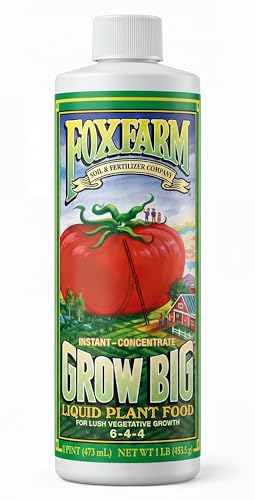
FoxFarm Grow Big Liquid Plant Food - 6-4-4 House Plant Fertilizer for Lush Vegetative Growth, Fast Nutrient Uptake for Roses, Tomatoes & Veggies - Pint Size Concentrate


As an Amazon Associate we earn from qualifying purchases. Product prices and availability are accurate as of the date/time indicated.
Prices shown are approximate and for reference only. Prices change often, so please check the current price on Amazon before you buy.
Best Nutrients for Beginners Tomatoes Growing in 2026: Detailed Reviews
1. General Hydroponics Flora Series — Best Overall Nutrients for Beginners Tomatoes Growing
Flora Series is a 3-part synthetic nutrient with FloraGro for vegetative growth, FloraMicro for micronutrients and calcium, and FloraBloom for flowering and fruiting. You mix them in order, with water between parts, or they can precipitate and lock out. That mixing order is important for all 3-part nutrients: add Micro first, then Gro, then Bloom, with water between, or mix each part in water before adding the next.
For tomatoes, start at half strength for seedlings, with EC around 0.8 to 1.2, like herbs and lettuce at half strength, then increase to full strength as plants grow, with EC around 1.5 to 2.5 for vegetative tomatoes and 2.0 to 3.0 for fruiting tomatoes. Check pH after mixing: 5.5 to 6.5 in hydroponics, 6.0 to 7.0 in soil. Adjust pH with pH up or pH down, and check EC with a meter.
Flora Series is synthetic, which means it is precise and it works well in hydroponics, where you need to know exactly what is in the water. It is also good for soil and coco. At $30 to $40 for a quart set, it will last a beginner a whole season for a few tomato plants. It is the nutrient to buy first if you want a reliable, well-documented line.
2. FoxFarm Trio — Best Nutrients for Beginners Tomatoes Growing in Soil
FoxFarm Trio is Grow Big for vegetative growth, Big Bloom for flowering, and Tiger Bloom for fruiting, at $40 to $50 for a quart set. It is a blend of synthetic and organic ingredients, and it is popular for soil growing, where it feeds both the plant and the soil microbes.
For tomatoes in soil, FoxFarm Trio is easy to use: use Grow Big during vegetative growth, then switch to Tiger Bloom and Big Bloom when flowers appear. Start at half strength, as FoxFarm nutrients are strong and can burn seedlings if used at full strength. Check pH in soil at 6.0 to 7.0, and water at 65 to 75 degrees Fahrenheit, which is the right range for hydroponic water and for soil watering.
The Trio is a good choice if you grow tomatoes in soil or in a grow tent with soil, and you want a nutrient line that is widely available and well known. It is less precise than Flora Series for hydroponics, because it contains organic ingredients that can clog hydroponic systems, so use it in soil, not in a recirculating hydroponic system.
3. Advanced Nutrients pH Perfect Grow / Micro / Bloom — Best Nutrients for Beginners Who Struggle With pH
Advanced Nutrients pH Perfect is a 3-part synthetic nutrient that automatically adjusts pH to the right range for hydroponics, 5.5 to 6.5, if your water is not too hard or too soft. That is useful for a beginner who struggles with pH, because pH is one of the hardest parts of hydroponic growing to get right.
At $40 to $60 for a litre set, pH Perfect costs more than Flora Series, but it saves time on pH adjustment. It works in hydro, soil, and coco, and it has separate Grow, Micro, and Bloom formulas like Flora Series. Mix in order, with water between parts, to avoid precipitation and lockout. Start at half strength for seedlings, then increase as plants grow.
The pH Perfect feature does not replace checking pH with a meter. Check pH regularly, especially if your tap water is hard, as the nutrient cannot correct for very hard water. For a beginner in hydroponics who wants less pH work, it is a good choice.
4. Dyna-Gro Grow 7-9-5 — Best Single-Part Nutrients for Beginners Tomatoes Growing
Dyna-Gro Grow is a single-part synthetic nutrient, at $20 to $30 for a quart, with an NPK of 7-9-5. Single-part means you do not need to mix three parts in order, which is simpler for a beginner. You just add it to water, check EC and pH, and feed.
For tomatoes, Dyna-Gro Grow is good for vegetative growth, but you may need a bloom nutrient for fruiting, or you can use Dyna-Gro Bloom separately. The single-part design is less precise than a 3-part design, because you cannot adjust nitrogen, phosphorus, and potassium separately, but for a beginner with a few tomato plants, it is enough. It works in hydro, soil, and coco, and it is the cheapest nutrient here.
5. Botanicare Pure Blend Pro Grow / Bloom — Best Organic-Based Nutrients for Beginners Tomatoes Growing
Botanicare Pure Blend Pro is an organic-based nutrient with Grow for vegetative growth and Bloom for fruiting, at $30 to $40 for a quart set. It is made from organic ingredients, so it is good for soil growing, where it feeds soil microbes as well as the plant.
For tomatoes in soil, Pure Blend Pro is a good choice if you want an organic-based nutrient without the complexity of compost tea. Compost tea is soil only, not hydro, because it clogs hydroponic systems and it has no EC, so it cannot be measured with an EC meter. Pure Blend Pro is different: it is a bottled nutrient with a measurable EC, so you can check strength with a meter.
Use Pure Blend Pro in soil, not in a recirculating hydroponic system, as organic ingredients can clog pumps and filters. Start at half strength, check pH at 6.0 to 7.0 in soil, and increase as plants grow.
6. Jack’s Nutrients 321 — Best Powder Nutrients for Beginners Tomatoes Growing
Jack’s 321 is a 3-part powder nutrient with Part A, Part B, and Epsom salt, at $30 to $40 for a kit. Powder nutrients are cheaper per gallon than liquid nutrients, and they last longer in storage, because they do not have water weight. Mix Part A first, then Epsom salt, then Part B, with water between parts, to avoid precipitation.
For tomatoes, Jack’s 321 is a good choice if you grow in hydroponics and you want a precise, cheap nutrient. It is synthetic, so it works well in hydro, soil, and coco, and it has a simple mixing ratio that is easy to remember: 3.6 grams of Part A, 2.4 grams of Part B, and 1.2 grams of Epsom salt per gallon, for a typical tomato feed. Check EC and pH after mixing, and adjust as needed. Powder nutrients need a scale to measure accurately, so buy a small digital scale if you choose Jack’s.
Best Nutrients for Beginners Tomatoes Growing Buying Guide
Choosing nutrients for tomatoes is about pH, EC, mixing order, and growing medium. A nutrient that works in soil may not work in hydroponics, and a nutrient that is easy in hydroponics may be too strong in soil.
pH Hydro 5.5-6.5 Soil 6.0-7.0, EC Herbs 0.8-1.2 Half Strength, Tomatoes 1.5-2.5 Veg 2.0-3.0 Fruit, Water 65-75 Degrees: Measuring Nutrients for Tomatoes
pH should be 5.5 to 6.5 in hydroponics, and 6.0 to 7.0 in soil. Check pH with a meter that is accurate to at least 0.1 pH, with 2-point calibration, and waterproof. A meter with accuracy of 0.2 pH or worse is below the gate and will not be accurate enough for tomatoes.
EC should be 0.8 to 1.2 for seedlings and for herbs like basil and lettuce at half strength, 1.5 to 2.5 for vegetative tomatoes, and 2.0 to 3.0 for fruiting tomatoes. Those are typical ranges, and you should check with an EC meter and adjust for your variety. If EC is too high, leaves will burn. If EC is too low, plants will be pale and slow.
Water temperature should be 65 to 75 degrees Fahrenheit, for hydroponic reservoirs and for soil watering. Cold water can shock roots, and warm water can encourage root rot. Use a thermometer to check water temperature, especially in a grow tent where the reservoir can warm up under lights.
Mix Nutrients in Order With Water Between Parts or Precipitate and Lockout, Synthetic Hydro Precise, Compost Tea Soil Only Not Hydro: Mixing Nutrients Correctly
Mix nutrients in order, with water between parts, or they can precipitate and lock out. For a 3-part nutrient like Flora Series, add Micro first, then Gro, then Bloom, mixing each in water before adding the next. For Jack’s 321, add Part A, then Epsom salt, then Part B, in that order. If you mix them together dry, or if you add them in the wrong order, they can form a solid precipitate that will not dissolve and that will lock out calcium and other nutrients.
Synthetic nutrients are precise for hydroponics, because you know exactly what is in the water and you can measure EC accurately. Organic nutrients are good for soil, because they feed soil microbes, but they are less precise for hydroponics. Compost tea is soil only, not hydro, because it clogs hydroponic systems, it has no EC, and it cannot be measured with a meter. Do not use compost tea in a hydroponic reservoir.
Light, Timer, Fan, and Tent Size: Growing Tomatoes Indoors With Nutrients
Light for tomatoes should be on a timer for 14 to 16 hours a day, with PPFD of 200 to 400 micromoles per square metre per second for herbs, and higher for tomatoes, with a typical range of 400 to 600 for vegetative tomatoes and 600 to 800 for fruiting tomatoes. Light wattage should be about 100 watts for a 2 by 2 foot tent, 200 watts for a 2 by 4 foot tent, 300 watts for a 3 by 3 foot tent, and 400 watts for a 4 by 4 foot tent.
Fan CFM should be about 100 for a 2 by 2 foot tent, 200 for a 2 by 4 foot tent, and 400 for a 4 by 4 foot tent, with a filter CFM at least as high as the fan, for negative pressure. Use an oscillating fan for circulation at canopy level, not as an exhaust fan. Relative humidity should be 40 to 60 percent for vegetative growth, and 40 to 50 percent for flowering and fruiting.
Net pots for hydroponics should be 3 inches for herbs and 5 inches for vegetables like tomatoes. Grow bags for soil should be 5 gallons for vegetables like tomatoes. CO2 bags should hang above plants, but they do not replace ventilation, so do not rely on them alone.
Best Nutrients for Beginners Tomatoes Growing FAQ
What is the best nutrients for beginners tomatoes growing?
The best nutrients for beginners tomatoes growing is the General Hydroponics Flora Series, 3-part, at $30 to $40 for a quart set, because it is easy to mix in order, it works in hydro, soil, and coco, and it has clear feeding charts for tomatoes. The FoxFarm Trio, at $40 to $50, is the best alternative for soil growing. The Dyna-Gro Grow, at $20 to $30, is the best single-part alternative for a beginner who wants simplicity.
What pH and EC should I use for tomatoes?
For tomatoes, pH should be 5.5 to 6.5 in hydroponics, and 6.0 to 7.0 in soil. EC should be 0.8 to 1.2 for seedlings at half strength, 1.5 to 2.5 for vegetative tomatoes, and 2.0 to 3.0 for fruiting tomatoes. Those are typical ranges, and you should check with a pH meter accurate to 0.1 pH and an EC meter, and adjust for your variety and your water. Water temperature should be 65 to 75 degrees Fahrenheit.
How do I mix nutrients for tomatoes without causing lockout?
Mix nutrients in order, with water between parts, or they can precipitate and lock out. For Flora Series, add Micro first, then Gro, then Bloom, mixing each in water before adding the next. For Jack’s 321, add Part A, then Epsom salt, then Part B, in that order. Start at half strength for seedlings, then increase to full strength as plants grow. Check EC and pH after mixing, and do not mix nutrients dry together.
Can I use the same nutrients for tomatoes in soil and in hydroponics?
Yes, you can use the same nutrients for tomatoes in soil and in hydroponics if the nutrient is designed for both, like General Hydroponics Flora Series, Advanced Nutrients pH Perfect, Dyna-Gro Grow, and Jack’s 321, which all work in hydro, soil, and coco. FoxFarm Trio and Botanicare Pure Blend Pro work best in soil, as they contain organic ingredients that can clog hydroponic systems. Compost tea is soil only, not hydro, because it clogs and has no EC. Use synthetic nutrients for hydroponics for precise EC control, and organic-based nutrients for soil if you want to feed soil microbes.
FAQ
What is the best nutrients for beginners tomatoes growing?
What pH and EC should I use for tomatoes?
How do I mix nutrients for tomatoes without causing lockout?
Can I use the same nutrients for tomatoes in soil and in hydroponics?
Related guides
- Far Red Supplemental Light Pros Cons: 6 Best Far Red Supplemental Light Pros Cons Picks in 2026
- Best Grow Tent Upgrade for Humidity Control: 6 Best Grow Tent Upgrade for Humidity Control Picks in 2026
- Best Grow Tent Pruning Shears for Growing in 2026: Best Grow Tent Pruning Shears for Growing for Clean Cuts, Easy Trimming, and Simple Indoor Growing
- Best LED Light for Beginners Garage Growing in 2026: How to Pick a Simple LED Grow Light That Works in a Garage for Vegetables and Herbs
More from Amazon
Programs that pair well with the guide above. Offers and eligibility are set by Amazon and may change.
Free shipping on eligible items, Prime Video and more. Eligible new members can start with a free trial.
Start a Prime free trialAudiobooks and podcasts to listen to on the go. Eligible new members can start with a free trial.
Try Audible freeAd-free music streaming. Eligible new subscribers can start with a free trial.
Try Music Unlimited freeA free business account with business pricing and bulk-buying tools for work, shop or home office.
Create a business accountAs an Amazon Associate we earn from qualifying purchases.



Write Your Review
No reviews yet. Be the first to share your experience!