
What's inside
As an Amazon Associate I earn from qualifying purchases. This post may contain affiliate links at no extra cost to you.
The best carbon filters for grow tent odor do a job with no partial credit: a tent in full flower either smells like nothing at all outside its door, or the filter system has failed, and the distance between those two outcomes is decided by sizing, carbon quality, and installation long before it is decided by brand. A carbon filter is not a perfume and not a mask; it is a bed of activated carbon, a material whose internal surface area is measured in acres per handful, through which the tent’s exhaust air is pulled so that odor molecules adsorb onto that surface and stay there. When the airflow is matched to the filter’s rating, when the carbon bed is deep and fresh, and when the tent runs at a slight negative pressure so that every leak flows inward, the system is silent and total. When any of those is wrong, the grow announces itself. This guide compares six real, currently sold carbon filters graded for tent odor duty specifically, teaches the sizing arithmetic that most odor failures are actually arithmetic failures, and covers the legal and neighborly common sense that frames the whole subject, since odor control is, at bottom, the discipline of a grow that minds its own business, in a jurisdiction where the grow itself is lawful, which every reader should confirm for their own address before the first seed.
Name the system’s three parts before the table, because a filter is only one of them and it gets blamed for the other two. The fan moves the air and must be sized with the filter, not against it: too weak, and the tent’s pressure and temperature both wander; too strong for the filter’s rating, and air rushes through the carbon bed faster than adsorption can work, a failure that smells like a filter problem and is actually a matching problem. The ducting and the installation decide whether the air truly passes through the carbon or sneaks around it, at the flange, at a torn prefilter, at a duct joint taped by optimism. And the tent’s pressure, slightly negative with the exhaust running, is the discipline that makes the filter the air’s only exit, so that the door’s zipper and the cable ports become inlets rather than leaks. The filters below are graded as components in that system, on carbon quality and bed depth, on the honesty of their airflow ratings, and on the prefilters and flanges that decide their installed life, because a filter is a promise that installation keeps or breaks.
Our Top Picks
 MELONFARM 4 Inch Air Carbon Filter Smelliness Control4"x11"Fifer6.93 x 6.93 x 13.78 inchesCheck on Amazon
Best Carbon Filters for Grow Tent Odor: Sizing and Carbon Science
The CFM Arithmetic: Match Fan, Filter, and Tent
Begin with the tent’s volume, length by width by height in feet, which for the standard 4x4x6.5 is a little over a hundred cubic feet, and the working rule that the tent’s air should exchange roughly once a minute at full demand, corrected for the realities the simple number ignores: the filter itself resists the fan, commonly costing a quarter to a third of its free-air rating, bends in the duct cost more, and heat from the light argues for margin. The practical method this guide teaches is to choose the filter first, by the tent’s size class, then choose a fan whose rating, after the filter’s discount, still covers the exchange with a controller’s headroom to run it below its maximum, since a fan at seventy percent is quieter, longer-lived, and kinder to the carbon’s contact time than a fan at its limit. Oversizing the filter one step, the 6-inch filter on the 4-inch fan’s tent through a reducer, is the connoisseur’s move, buying a deeper bed and a slower airspeed through it, which is adsorption’s favorite condition, at the price of a larger can in a small tent’s ceiling. The table’s rows are annotated by tent class for exactly this arithmetic, and the odor failures this guide has diagnosed over the years have been, in order, an undersized filter, an oversped fan, and a leak, with a genuinely exhausted filter a distant fourth.
Activated Carbon: Virgin, Coal-Based, and the Bed’s Depth
Not all carbon is the same material wearing a name. The better filters specify virgin activated carbon, coconut-shell or high-grade coal-based, whose pore structure is the adsorption engine, and they publish the bed’s depth, the thickness of carbon the air must cross, with the serious class running deeper than the budget’s. Depth is time: a deeper bed holds the air’s odor molecules in contact longer and holds more of them before saturation, which is the filter’s lifespan measured in grows rather than in months. The budget filters’ carbon is not fake, but it is commonly a thinner bed of a less specified material, and its honest service life in a flowering tent is a grow or two against the premium bed’s several, an arithmetic that reprices the table’s rows for anyone who does the division. Humidity is carbon’s environmental enemy, since water vapor competes for the pores, which is why a tent run chronically above sixty percent humidity shortens every filter’s life and why the climate discipline in this site’s other guides is also, indirectly, an odor discipline. Buy the deepest bed your tent’s ceiling and your fan’s strength allow, and the replacement calendar stretches from a worry into a routine.
Prefilters, Flanges, and the Installed Life
The white sleeve on the filter is not packaging; it is the prefilter, the dust defense that keeps the carbon’s pores for odor rather than for the tent’s lint and leaf dust, and it is a consumable, washed or replaced when it grays, since a clogged prefilter strangles the fan and mimics a dead filter so convincingly that good carbon gets retired for its sleeve’s sins. The flange and the duct joint are the system’s honesty test: a filter clamped and taped so that no air bypasses the bed, because air, like water and electricity, takes the easiest path, and the easiest path around a badly sealed filter is the odor’s escape route. Inside the tent versus outside is the last installation choice, the filter hung in the tent’s ceiling pulling air through itself being the standard for odor, since it scrubs before the duct run and keeps any duct leak on the clean side of the system. Grade the table’s rows partly on these fittings, the reversible flanges that double a filter’s life by letting it be flipped end for end, the prefilter’s quality and availability, because a filter is bought once and installed forever, and the installation is where its rating is either kept or spent.
Best Carbon Filters for Grow Tent Odor: Quick Comparison
| Carbon Filter Model | Key Specs | Best For | Typical Price Range | Rating |
|---|---|---|---|---|
| AC Infinity Carbon Filter (4 and 6 inch class) | Australian virgin charcoal positioning in line, deep bed class, reversible flange in class, premium prefilter | Best carbon filters for grow tent odor overall | $50 – $90 by size | 4.7 / 5 |
| Phresh Filter (Hyper Fan line class) | Premium activated carbon heritage, tall bed designs in class, professional grow positioning | Best premium and long-life | $90 – $160 by size | 4.6 / 5 |
| Can-Fan Can-Lite Filter | Lightweight can class, established hydroponics brand, multiple sizes in line | Best lightweight for small tent ceilings | $60 – $110 by size | 4.4 / 5 |
| TerraBloom Carbon Filter | Virgin charcoal positioning in line, machine-packed bed claims in class, value pricing | Best mid-price value | $40 – $75 by size | 4.3 / 5 |
| VIVOSUN Carbon Filter | Activated charcoal in class, reversible flange positioning, tent-ecosystem pricing, prefilters included in class | Best budget ecosystem buy | $35 – $65 by size | 4.1 / 5 |
| iPower Carbon Filter | Virgin charcoal positioning in line, wide size range, budget pricing | Best rock-bottom budget | $30 – $60 by size | 4.0 / 5 |
MELONFARM 4 Inch Air Carbon Filter Smelliness Control with Australia Virgin Charcoal, Odor Removal Carbon Filter for Grow Tent, Inline Fan, Hydroponics, Pre-Filter Included, Insulated Flange 4" x 11"


As an Amazon Associate we earn from qualifying purchases. Product prices and availability are accurate as of the date/time indicated.
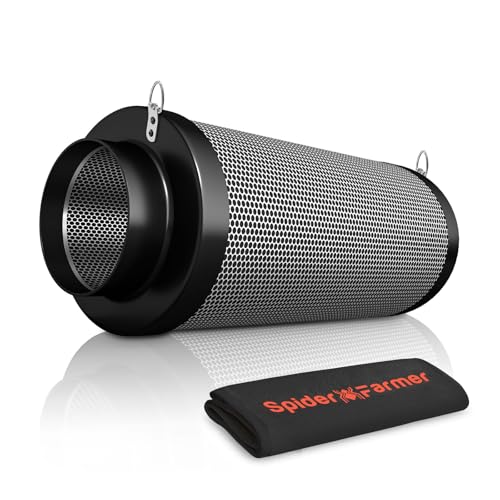
Spider Farmer 4 Inch Carbon Filter for Grow Tent Odor Control | Made with Australian virgin charcoal, includes pre-filter and reversible flange for inline duct fan and hydroponics
As an Amazon Associate we earn from qualifying purchases. Product prices and availability are accurate as of the date/time indicated.

ATOUR 4 Inch Activated Carbon CFF4 Air Filter with Dual Built-in Fans – Reversible Airflow for Intake or Exhaust, Odor Scrubber for Grow Tent, Hydroponics, Basement Ventilation
As an Amazon Associate we earn from qualifying purchases. Product prices and availability are accurate as of the date/time indicated.
Prices shown are approximate and for reference only. Prices change often, so please check the current price on Amazon before you buy.
Sizes are by duct diameter; match the filter’s rated airflow to your fan and tent per the guide’s arithmetic. Ratings are editorial, weighing carbon quality and bed depth, rating honesty, prefilter and flange quality, service life, and value.
The Six Grow Tent Carbon Filters Reviewed
1. AC Infinity Carbon Filter: Best Overall
AC Infinity’s filters lead the table on the system’s thinking its maker is known for: virgin charcoal of a specified grade in a bed of serious depth, a reversible flange that lets the filter be flipped to even its wear, a prefilter of genuine quality, and ratings published with the restraint that lets the CFM arithmetic in this guide actually work. Paired with the same line’s fans and controllers, it becomes the managed system the odor discipline dreams of, the fan holding its speed against the filter’s load and the tent’s pressure staying where it was set. Its price is the premium class’s lower edge, its sizes cover the tent world’s standards, and for the grower whose odor control is a necessity rather than a preference, it is the default this guide defends, because its whole design assumes the user will check its work, and it passes.
2. Phresh Filter: Best Premium Long-Life
Phresh is the professional shelf’s name, the filter line the commercial small-grow world standardized on, with tall, deep beds of premium carbon that translate, in tent service, into the longest replacement intervals in this table. Its cans are larger and heavier, a ceiling consideration the small tent must measure, and its price is the professional’s, justified by the division this guide taught: cost per grow, across several grows, against the budget bed’s cost per grow across one. For the perpetual grower, harvesting and flowering in rotation without a dark month, the Phresh’s stamina is the whole review, since a filter changed on a calendar rather than on a failure is a filter that never announces the grow at the worst moment, which is the entire point of the exercise.
3. Can-Fan Can-Lite: Best Lightweight
The Can-Lite answers the small tent’s structural question: a serious carbon bed in a can light enough for a 2×4’s ceiling bars and a closet tent’s frame to carry without a sag, from one of hydroponics’ founding ventilation brands. Its bed is the lighter class’s by design, trading some lifespan for the weight, and its honest home is the small-to-mid tent whose fan and filter must both live overhead. Can-Fan’s longevity in the industry makes its ratings and its replacement prefilters reliable citizens. For the tent whose ceiling is the constraint, it is the professional answer at a carryable weight, and its rating reflects a compromise chosen deliberately rather than suffered.
4. TerraBloom Carbon Filter: Best Mid-Price Value
TerraBloom competes in the honest middle: specified charcoal, a machine-packed bed whose evenness the maker argues for, reversible mounting in its class, and pricing a clear step below the leaders with performance a clear step above the floor. Its prefilters and finish are its class’s, sound rather than luxurious, and its ratings have earned it a following among growers who do the CFM arithmetic and find it accurate, the compliment this guide weighs most. For the 4×4 grower equipping a first serious tent, it is the value row that does not require the apology paragraph the budget rows carry, and its existence keeps the leaders’ prices honest, a public service in itself.
5. VIVOSUN Carbon Filter: Best Budget Ecosystem Buy
VIVOSUN’s filter is the tent kit’s own: priced to bundle, sized to the line’s tents and fans, with the reversible flange and prefilter the doctrine requires, and a bed whose honest life in a flowering tent is the budget class’s, a grow or two of full service before the replacement arithmetic arrives. Its virtue is system coherence at a price that gets a first grow legal, quiet, and odor-controlled in one order, and its owners graduate to the leaders’ beds with their second filter, having learned the discipline on the affordable one. Graded as a first filter rather than as a final one, it earns its row, and the guide’s only insistence is that its replacement be budgeted from the day it is hung, since a budget filter run past its life is the odor failure that gives the whole category its anecdotes.
6. iPower Carbon Filter: Best Rock-Bottom Budget
iPower’s filters are the category’s floor, charcoal beds in the standard sizes at prices that make odor control available to the smallest grow, with the class’s expected footnotes: a thinner bed, a shorter flowering life, and ratings to be matched conservatively, the fan run a step gentler than the arithmetic’s maximum. For the micro grow, the single plant in the closet tent, the loads are small enough that even the floor’s bed serves respectably, and proportion is this site’s standing virtue. Buy it sized generously, keep its prefilter clean, and replace it on the early side of suspicion, and it will do the one job it was bought for at the lowest price the job is honestly sold at.
Buying Guide: How to Choose the Best Carbon Filter for Your Grow Tent
Step One: Do the Arithmetic and Size One Step Generously
Compute the tent’s volume, choose the exchange target from this guide’s opening, and select the filter whose rated airflow, with the fan’s output discounted for the filter’s resistance, still clears the target with the controller’s headroom to spare. Where the choice falls between sizes, take the larger, since the deeper bed and the slower airspeed repay the difference in lifespan and in silence, and confirm the can’s physical dimensions against the tent’s ceiling, its length along the bars and its weight against the frame’s rating, with the hanging straps in the same order. Match duct diameter throughout, filter, fan, and ducting in one size, with reducers used only where the oversize strategy deliberately puts them, and buy the clamps and the foil tape in the same sitting, because an installation postponed for a clamp is an installation improvised, and improvisation is where bypass leaks are born.
Step Two: Install for Negative Pressure and Zero Bypass
Hang the filter inside the tent’s ceiling, connect it to the fan in the pull configuration the standard doctrine prescribes, filter, then fan, then duct out, with every joint clamped and taped and the prefilter seated clean before the first run. Seal the tent’s other openings to their working minimum, cable ports cinched, intake screened or light-trapped as the design requires, and test the result with the oldest instrument in ventilation: close the tent, run the exhaust, and watch the walls breathe inward slightly and hold, the visible signature of the negative pressure that makes the filter the only way out. Check with a hand at every seam and port for outward leaks, and with the room’s air, an hour into a flowering day, for the verdict that matters. An installation that passes those three tests, walls, hand, and nose, will hold for the filter’s life, and one that fails any of them is fixed at the joint, not at the store, since no filter in this table can scrub air that never met it.
Step Three: Maintain the Prefilter and Replace on the Calendar
The filter’s service life is managed, not merely spent. The prefilter comes off monthly in a working grow, washed or vacuumed and dried fully before it returns, because its clogging is the fan’s slow strangulation and the system’s most misdiagnosed failure. The tent’s humidity is held in the range the plants and the carbon both prefer, since the saturated tent taxes the bed’s pores with water before the odor ever arrives. The filter itself is flipped end for end at the season’s turn where its flange allows, evening the bed’s wear, and it is replaced on the evidence of the nose at the exhaust, tested honestly by a second nose where possible, at the first return of odor through a clean prefilter and a sealed system, which is the bed’s retirement announced in the only language it speaks. Log the install date in the grow journal, keep the spare prefilter on the shelf, and budget the replacement as a consumable of the grow, like nutrients and medium, because a carbon filter is not a fixture. It is a supply, and the growers whose tents never smell are the ones who always treated it that way.
Frequently Asked Questions About Carbon Filters for Grow Tent Odor
How long does a carbon filter last in a grow tent?
In flowering service, the honest range runs from a single grow for the budget beds to several grows, a year or more of perpetual service, for the premium deep beds in this table, with the variables being the grow’s odor load, the tent’s humidity discipline, and the prefilter’s maintenance. A filter’s decline is gradual and then sudden in perception: the bed saturates progressively, and the first faint return of odor at the exhaust, through a clean prefilter and a sealed installation, is the retirement notice, to be acted on rather than debated, since the margin between faint and announced is short. Flipping a reversible filter extends its even service, storing a spare in its sealed packaging keeps it fresh indefinitely, and the calendar in the grow journal, install date and grows served, turns replacement from an emergency purchase into a planned one. Treat the filter as the grow’s most important consumable and it will never surprise you, which is the whole of its job description.
Can a carbon filter remove all smell from a grow tent?
From the exhaust air, effectively yes, when the system in this guide is whole: a correctly sized and matched filter, installed without bypass, in a tent held at negative pressure, reduces the exhaust’s odor below what a nose at the duct can detect, which is the standard the category is graded by. The qualifications are the system’s, not the carbon’s: odor also leaves a tent on the grower’s clothes and hands, through the door during the long admiring inspection, and from the harvested material drying elsewhere in the house, none of which any filter can govern. Inside the tent’s own discipline, keep the door’s open time purposeful during peak flower, handle plants and then change the shirt that visited them before the dinner party, and dry the harvest inside the tent’s exhausted space where the law and the layout allow. The filter handles the air; the grower handles the rest, and together they are complete, which is why odor control is taught on this site as a system and a habit rather than as a product.
Should the carbon filter go inside or outside the tent?
Inside, pulling air through itself and then out through the fan and duct, is the standard this guide prescribes for odor duty, for two reasons that compound: the air is scrubbed at the first inch of its journey, so every downstream joint and duct run carries clean air whose leaks do not matter, and the filter’s body is protected inside the tent’s climate rather than aging in the room’s. The outside arrangement, the fan pushing air through a filter standing in the room, works and is sometimes forced by a tiny tent’s ceiling, but it pressurizes the duct run with unscrubbed air, making every joint a potential leak of the very thing being hidden, and it spends the filter’s life on the room’s dust as well as the tent’s. Where outside is unavoidable, seal the duct joints with a plumber’s conscience and accept the arrangement knowingly. In every case, the filter’s airflow direction, marked on the can, is obeyed, since a bed run backwards wears unevenly and voids the design’s intent.
Is it legal and safe to grow indoors with a carbon filter setup?
The filter and the ventilation are legal everywhere this guide knows of, being ordinary horticultural equipment, and their safe installation follows the electrical and fire habits this site teaches for all tent systems: fans and controllers on proper circuits, cords dressed and dry, no daisy-chained power strips, and equipment from makers with real certifications where your jurisdiction values them. The grow itself is a separate question with a local answer: plant counts, licensing, and legality vary by jurisdiction and change over time, and every grower must confirm their own position under their current local law before planting, and comply with their lease and their insurer where those apply. Odor control sits inside that compliance as good citizenship rather than as concealment in this guide’s framing, the same courtesy as a quiet fan and a tidy yard, extended to neighbors who did not choose to share the hobby. Grow lawfully, ventilate properly, and the carbon filter is what it should be, the equipment of a considerate gardener, in a tent that smells like nothing at all.
Related guides
- Hydroponic Lettuce vs Soil Lettuce Growing in 2026: Speed, Taste, Cost, and Which System Fits Your Tent, Counter, and Budget
- Best Grow Tent for Dry Climate Growing in 2026: Tents That Hold Humidity, Seal Tight, and Keep VPD in Range in Arid Rooms
- Best Size Aquarium for Full Grown Bearded Dragon in 2026: 6 Aquariums and Terrariums From 40 to 120 Gallons, With a Size of at Least 48 x 24 x 24 Inches, and a Price Range, for a Full Grown Bearded Dragon
- Best pH Meter vs Test Strips Growing in 2026: How to Pick a pH Meter vs Test Strips for Growing That Gives Accurate Readings, Is Easy to Use, and Works for Your Vegetables and Herbs
More from Amazon
Programs that pair well with the guide above. Offers and eligibility are set by Amazon and may change.
Free shipping on eligible items, Prime Video and more. Eligible new members can start with a free trial.
Start a Prime free trialAudiobooks and podcasts to listen to on the go. Eligible new members can start with a free trial.
Try Audible freeAd-free music streaming. Eligible new subscribers can start with a free trial.
Try Music Unlimited freeA free business account with business pricing and bulk-buying tools for work, shop or home office.
Create a business accountAs an Amazon Associate we earn from qualifying purchases.

Write Your Review
No reviews yet. Be the first to share your experience!